
The best food for a train trip is compact, low-mess and easy to eat cold: one sturdy main, two tidy sides, one shelf-stable backup snack and water. Pack everything in sealed portions, keep perishable food properly chilled, and put the first meal where you can reach it without unpacking your luggage.
A train lunch is different from a bag of car snacks. You may eat at a small shared table, have no reliable refrigerator or microwave, and need to carry every wrapper until the next bin. The goal is a real meal that survives the journey without leaking, smelling strongly or taking over the seat.
Choose food by the length of your train trip
For a trip under four hours
One complete lunch is usually enough: a sandwich or wrap, firm fruit, a crunchy vegetable and a drink. Add a small dry snack in case the train is delayed. If you leave just after breakfast or arrive before lunch, reverse the balance and pack one substantial snack plus a simple backup.
Choose food you already know travels well. A day of travel is not the best time to test a delicate dressing, an overfilled wrap or a container with a questionable seal. If you plan to buy food onboard, still bring water and one dependable snack because service and stock can vary.
For a long or overnight journey
Plan by eating moment, not by filling one giant box. Pack an early meal, a later snack and a shelf-stable reserve in separate portions. Keep the first meal at the top, the reserve closed, and anything for tomorrow in the coldest part of the insulated bag.
For a very long route, choose one packed meal and budget for a station or onboard purchase rather than carrying several risky perishable meals. Check the operator’s current food policy, onboard service and station stops before shopping; rules and facilities differ by railway, route and ticket type. For a two-day route with meals planned day by day, see food for a 2-day train journey.

12 food ideas for a train trip
Hummus and roasted-vegetable wrap: spread hummus thinly, use well-drained vegetables and wrap tightly in paper before placing it in a container. Keep it cold.
Turkey, cheese and greens sandwich: choose sturdy bread, put dry greens next to the bread and pack juicy tomato separately. Use an ice source for meat and cheese.
Bean and grain salad: combine firm grains, beans, roasted vegetables and herbs. Carry a small sealed dressing only if the undressed salad feels too dry.
Cold noodle box: use short noodles, edamame or tofu, shredded carrot and a light dressing. Avoid a container filled with loose sauce.
Mini frittata and bread: a baked egg portion, roll or crackers and raw vegetables make a compact meal, but the egg must stay cold.
Cheese, crackers and fruit box: portion firm cheese, plain crackers, grapes or apple and roasted seeds. This is easy to eat in stages and easy to scale.
Peanut-free seed-butter sandwich: use sunflower-seed or another suitable spread with banana packed separately. Check allergies and operator restrictions for your group.
Savoury muffin box: pair a vegetable or cheese muffin with fruit and a small protein-rich side that fits your storage plan.
Chickpea pita pockets: pack the chickpea filling in the pita only when it is thick and well drained; otherwise assemble at your seat with a spoon.
Thermos soup or stew: use a food thermos designed to hold safe temperatures, preheat it as instructed and choose a thick soup that will not splash easily.
Oat and dried-fruit bites: these work as a dry backup, not necessarily as the whole meal. Portion them so the reserve stays closed until needed.
Simple station picnic: buy a plain roll, whole fruit, an individually packed item and water after security or at the station when local rules make home packing impractical.
Swap within the same role. A wrap can become a sandwich, chickpeas can replace meat, firm pear can replace berries, and roasted seeds can replace nuts. The best train food matches the traveler’s allergies, storage equipment and ability to eat comfortably in a moving carriage.
Build one complete train lunch
Use a five-part formula
Start with one main that can be held in one hand or eaten from one container. Add one fresh side, one crunchy side, a small backup and water. The fresh side brings contrast; the crunchy side keeps the meal satisfying if the main softens; the backup covers a delay without forcing you to open tomorrow’s food.
Avoid packing five variations of the same texture. A soft wrap, yogurt, ripe peach and creamy dip may taste good at home, but together they create a fragile, wet lunch. Balance them with firm fruit, snap peas, pretzels, crackers or roasted chickpeas.
Three complete examples
The classic box: a turkey and cheese sandwich, cucumber sticks, an apple, pretzels and an oat bar. Keep the sandwich cold and leave the bar sealed as the delay reserve.
The vegetarian box: a hummus and roasted-pepper wrap, grapes, roasted chickpeas, a savoury muffin and water. Use a cold source for the wrap and muffin when their ingredients require refrigeration.
The no-assembly box: a grain-and-bean salad, firm pear, crackers, dried fruit and a spoon. Put the salad in the only container you need to open for the main meal.
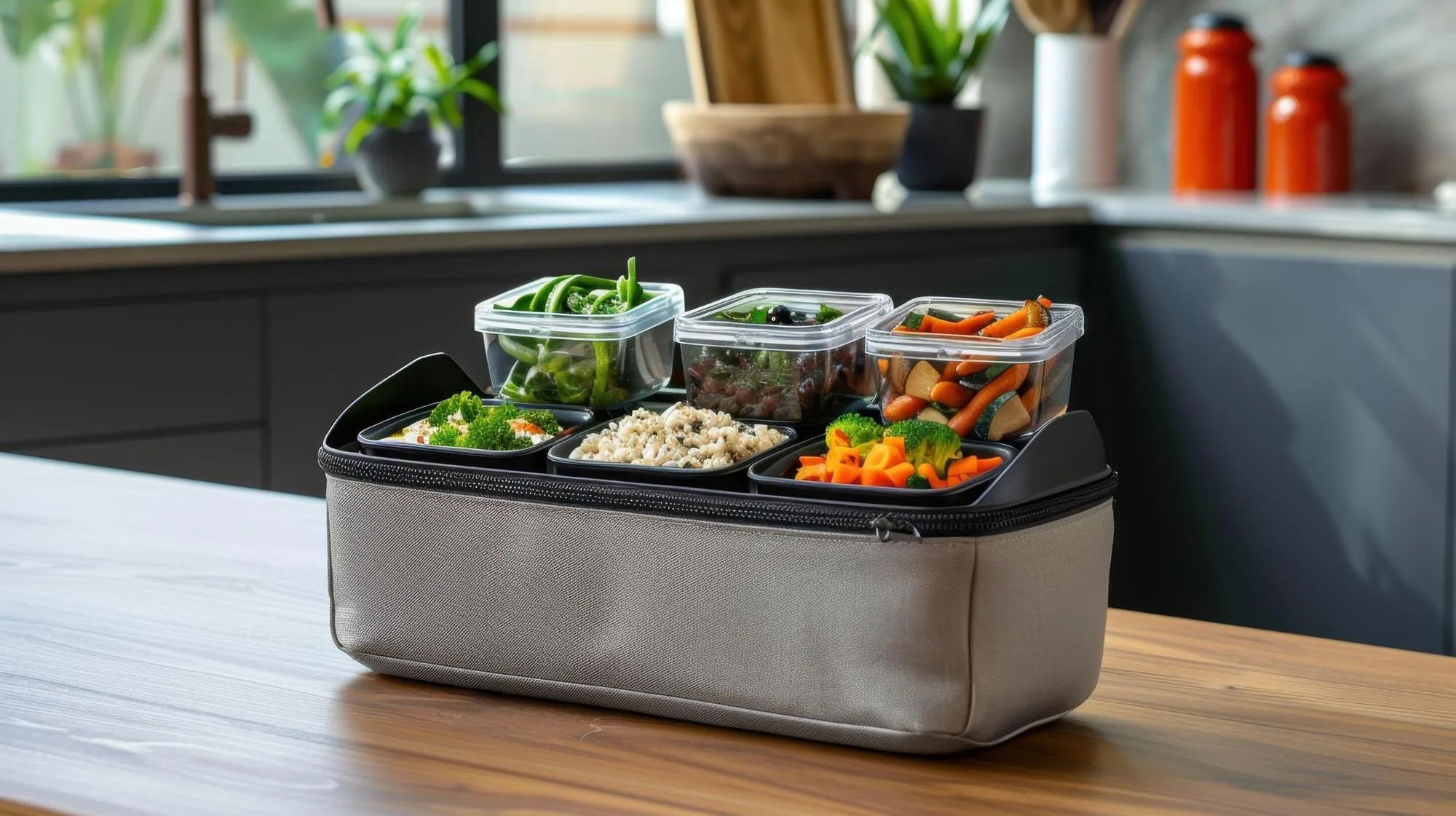
Pack for a small seat and a moving carriage
Test every seal before travel day
Fill each liquid-safe container with water, close it and hold it upside down over the sink. A lid that works upright in the refrigerator may leak when a backpack is turned. Put dressings and dips in small screw-top containers, not loose snap-lid cups, and keep them inside a second washable pouch.
Cut food into bite-size pieces at home. Remove pits, stems and messy peels. Bring one spoon or fork, a napkin, a hand wipe and a small bag for rubbish. Choose containers that fit on your lap or the tray without balancing several open lids.
Pack in the order you will eat
Place the first meal at the top of the food bag, with its utensil and napkin. Put later snacks below it and keep the emergency reserve sealed. Store food separately from shoes, chargers and anything that could puncture a container.
Do not rely on a large suitcase in a rack when you may need food between stops. Keep the food bag light enough to control with one hand and compact enough that it does not occupy another passenger’s space.
Choose packaging that travels well
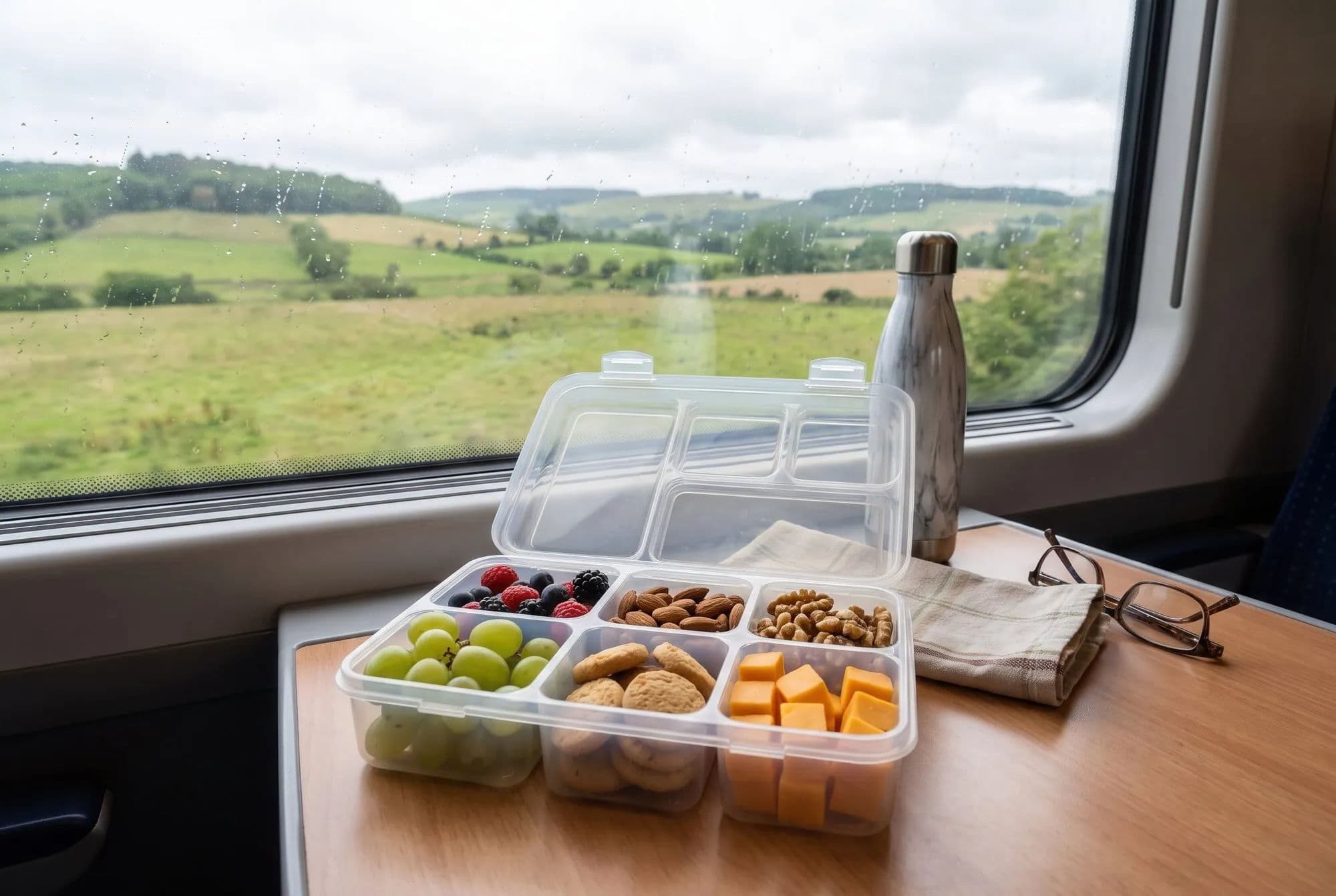
The best packaging for train food is boring and secure. A bento-style box with fixed compartments keeps the main and sides apart, a screw-top jar or small food thermos holds anything wet, paper or a reusable wrap stops a sandwich from sweating, and a zip bag keeps dry snacks from being crushed. Put cold items in a soft insulated bag with ice packs, and leave glass at home if the carriage will be crowded.
If you travel with others, label each container with the meal it belongs to. Choose lids you can open with one hand, and pack one spare bag for used containers so they do not touch clean food.

Keep food safe without train refrigeration
Keep perishable food properly cold
USDA guidance for packed lunches recommends an insulated bag and at least two cold sources for perishable food, placed above and below it. Chill the food before packing, keep the bag closed and do not assume an air-conditioned carriage is cold storage. Read the current USDA packed-lunch guidance.
Meat, eggs, dairy, cooked grains, cut fruit and many prepared dishes need temperature control. When you cannot maintain it, choose shelf-stable food or buy a fresh meal closer to the time you will eat. A frozen drink can be one cold source only if it is appropriate for the container and remains cold enough; follow local guidance and product labels.
Respect time and hot-food limits
USDA uses a two-hour limit for perishable food at room temperature, shortened to one hour above 90°F/32°C. Count all uncontrolled time, including the trip to the station and the wait on the platform. When in doubt, discard the food rather than judging safety by smell.
A food thermos is useful only when it can hold hot food safely. Preheat it, fill it with thoroughly heated food and keep it closed until eating, following the manufacturer’s instructions and local food-safety guidance. Train staff may not be able or permitted to heat personal food.
How to heat food on a train
What heating options trains offer
Plan as if you cannot. Many trains have no microwave for passengers, and some operators state that staff cannot heat personal food. Some long-distance services sell hot meals in a dining or café car, and some sleeper trains offer hot water for tea, but this varies by route, train and season. Check the official page for your service and treat any heating option as a bonus, not the plan.
When hot water is available, instant oats, couscous, noodle cups or soup sachets become easy warm meals; the 2-day train journey guide shows how to plan around boiling water. Handle it carefully in a moving carriage: use a cup with a lid and fill it only partly.
Keep hot food hot in a food thermos
A wide-mouth food thermos is the most reliable way to have a warm meal without train facilities. USDA advice is to fill the insulated container with boiling water, let it stand for a few minutes, empty it, then add piping hot food and keep the lid closed until you eat. Heat the food thoroughly at home just before leaving rather than packing it lukewarm.
Thick soups, stews, chili, porridge, rice with sauce and pasta in a little sauce hold heat better than thin broth. Eat the thermos meal first, within the time the manufacturer suggests, and do not save half of it for later in the trip.
Pack food that tastes good cold
The simplest answer is to choose dishes that need no heating at all: wraps, grain salads, cold noodles, savoury muffins, frittata, cheese and crackers. Food designed to be eaten cold usually tastes better than a hot dish eaten cold, and it removes the question of facilities completely.
Train food in summer
What to pack for a summer train trip
On a hot day choose fewer perishable items and more food that tolerates warmth: whole fruit, raw carrots and snap peas, crackers, bread rolls, roasted chickpeas, seed mixes and unopened shelf-stable portions. Keep the one perishable meal small and eat it early. Skip mayonnaise-heavy salads, cream desserts, soft cheese and chocolate that melts over everything.
Bring more water than you think you need, especially if the air conditioning is unreliable, and freeze one bottle so it works as an extra cold source you can drink later.
Keep the bag cold on a hot day
Pre-chill the insulated bag, pack it straight from the refrigerator and place ice packs above and below perishable food. Keep the bag out of direct sun by the window, on the floor or under the seat rather than on a sunny shelf, and open it only when you take something out.
The USDA limit drops to one hour above 90°F/32°C, and a platform or a carriage without air conditioning can reach that easily. If the ice packs have fully thawed and the food feels warm, throw perishable items away.
Follow train etiquette and operator rules
Check the exact railway before packing
Policies differ. As one current US example, Amtrak says passengers may bring personal food for consumption at their seat or private sleeping accommodation, while its staff cannot handle, refrigerate or heat that food. Check the current Amtrak personal-food policy or the equivalent official page for your operator before departure.
Do not assume that a dining car, microwave, boiling water or refrigerator will be available. Check restrictions on alcohol, knives, glass, allergens and where personal food may be eaten. International journeys can also involve customs or agricultural limits on food carried across borders.
Reduce smell, noise and rubbish
Choose mild-smelling food, open one container at a time and avoid dishes that require vigorous cutting or mixing. Skip very ripe eggs, oily fish, loose soup and brittle packaging in a crowded carriage. If a food could spill when the train brakes, it belongs in a deeper sealed container.
Pack out what you bring until you find the correct bin. Wipe the table before and after eating, keep allergens contained and ask before sharing food. A considerate meal is compact enough to stay within your place.
Use a simple shopping and prep checklist
The day before departure
Choose the main and two sides, check dietary needs, confirm the operator’s rules and freeze the cold sources. Wash produce, cook components, cool cooked food promptly and portion dry snacks. Put utensils, wipes and a rubbish bag beside the food containers.
Review the cold lunch ideas guide when you need more no-reheat combinations. If your journey continues by car, the separate road trip snacks guide covers driver safety, rest stops and a car cooler.
Before leaving for the station
Pack food straight from the refrigerator, add the cold sources and close the insulated bag. Fill water where permitted, put the first meal on top and check that the reserve snack remains sealed. Note when perishable food left controlled refrigeration so you can make a real safety decision later.
Eat a normal meal before a very early departure rather than expecting snacks to solve everything. A modest, planned lunch is easier to carry than a bag filled for every possible delay.
Plan travel food once in Dishday
Save the main meal and two useful snacks in Dishday, put the travel day in the meal planner, and move only the missing ingredients into the grocery list. Keep a reusable “short train trip” set and a separate “long train trip” set so quantities and storage needs stay clear.
Dishday can organize recipes, timing and shopping, but it cannot verify a railway rule, an allergen, a seal or the temperature inside your lunch bag. Those checks stay with the traveler.
Frequently asked questions
What food is best for a train journey?
A sturdy sandwich or wrap, firm fruit, crunchy vegetables, a dry snack and water make a reliable base. Choose food that is easy to eat cold, fits in one container and matches the cold storage you can maintain.
What food can I take on a train without refrigeration?
Options may include unopened shelf-stable foods, whole firm fruit, plain crackers, bread, dried fruit and roasted seeds. Read labels carefully: cheese, meat, eggs, cut produce, cooked grains and many prepared foods still require chilling.
How do I stop sandwiches getting soggy on a train trip?
Use sturdy bread, cool the filling before assembly, dry vegetables well and place lettuce or cheese next to the bread as a barrier. Pack tomatoes, pickles and dressing separately when they release a lot of moisture.
Can you heat food on a train?
Do not count on it. Many trains have no microwave for passengers, and some operators say staff cannot heat, handle or store personal food. A dining car or hot water may be available on some routes; check the official page for your service and bring a preheated food thermos or meals that are good cold.
What should I pack for children on a train?
Use familiar foods in small portions, a spill-resistant bottle and only items appropriate to the child’s age and eating skills. Avoid choking hazards, check allergens, keep perishables cold and bring enough wipes plus one calm backup snack.
How do I keep food fresh on a train in summer?
Pack perishables straight from the refrigerator into a pre-chilled insulated bag with ice packs above and below, keep the bag out of the sun and eat the perishable meal first. Bring mostly whole fruit, raw vegetables and dry snacks, and throw away perishable food that has become warm.
Pack a meal you can actually eat
Choose one main, two contrasting sides, a sealed backup and water. Test the containers, protect perishables with reliable cold sources and keep the first meal within reach. To save the combination and turn it into one shopping list, download Dishday on the App Store.